
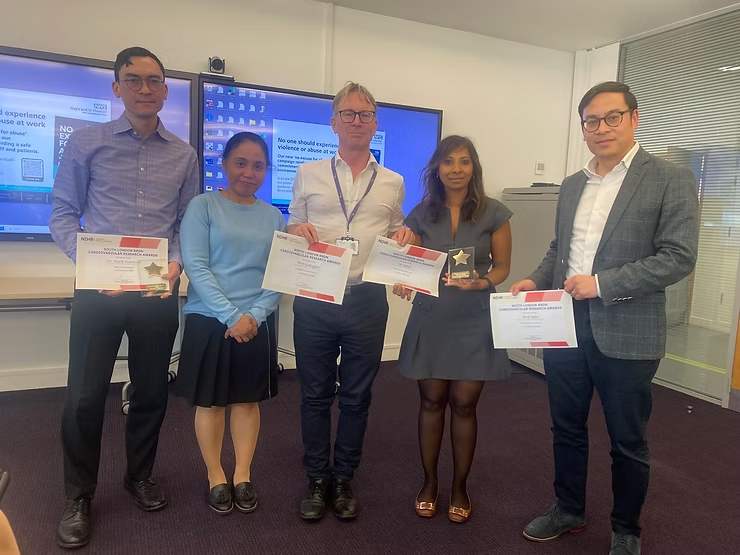
St George’s cardiology research teams have been recognised at the NIHR Research Delivery Network Annual Specialty Group Meeting and Cardiovascular Research Awards, celebrating their outstanding contribution to cardiovascular research, innovation and patient-centred care.
Dr Mark Peterzan, Heart Failure Consultant at St George’s, received the Most Promising New Principal Investigator Award. As one of the newest Principal Investigators to join the cardiology research portfolio, Dr Peterzan has already opened three new heart failure studies, strengthening the Trust’s role in delivering national and international Heart Failure research.
These include BRANCH-HF, a Phase 2 randomised, double-blind, placebo-controlled study evaluating the efficacy and safety of an oral branched-chain ketoacid dehydrogenase kinase inhibitor, PF-07328948, in adults with heart failure; MARITIME-HF, a Phase 3 randomised, double-blind, placebo-controlled study evaluating the efficacy and safety of Maridebart Cafraglutide on mortality and morbidity in participants living with heart failure with preserved or mildly reduced ejection fraction and obesity; and HF-POLARIS, which is evaluating the efficacy and safety of NNC0487-0111 compared with placebo on morbidity and mortality in people with heart failure with preserved or mildly reduced ejection fraction and obesity.
The purpose of HF-POLARIS is to assess whether NNC0487-0111 can reduce a composite endpoint including cardiovascular death, heart failure hospitalisation or urgent heart failure visits in participants with heart failure with preserved or mildly reduced ejection fraction and obesity.
As a Trust with a dedicated Heart Failure Unit, delivering studies like these is vital in advancing cardiology research, improving early detection of cardiac abnormalities, and strengthening evidence-based clinical care for current and future heart failure patients.
The St George’s Electrophysiology Team was also recognised, receiving the Research Group of the Year Award. The award celebrates the work of Dr Manav Sohal, Professor Mark Gallagher, Professor Magdi Saba and Dr Anthony Li, whose leadership has helped expand the cardiology research team’s portfolio of electrophysiology studies over recent years.
This growth has strengthened St George’s contribution to cardiovascular research and innovation, while enhancing patient care by increasing access to advanced therapies, supporting earlier diagnosis and intervention, and enabling patients to benefit from emerging treatments and evidence-based clinical practice within a specialist setting.
Professor Mark Gallagher currently leads the SECURE study at St George’s, an observational post-marketing study evaluating the ongoing safety and effectiveness of catheter mapping and ablation using commercially approved BWI medical devices for the treatment of patients with cardiac arrhythmias. Recruitment at St George’s has reached 500 patients, reflecting the scale and impact of the team’s research delivery.
Professor Magdi Saba and Dr Anthony Li have also recently co-authored a significant 2025 publication in Circulation: Arrhythmia and Electrophysiology. Their research explores how MRI-based personalised cardiac “digital twins” can non-invasively predict ventricular tachycardia circuits and guide optimal ablation targets before procedures.
This research is particularly significant because it combines cardiac MRI, computational modelling, electrophysiology mapping and precision medicine approaches to create personalised virtual heart models. These models may help improve procedural success, reduce recurrence rates and support more tailored treatment planning for patients with complex arrhythmias.
Dr Manav Sohal, Cardiology Care Group Lead, has also provided significant support to the cardiology research portfolio. He is St George’s Hospital Principal Investigator for the AVEIR Leadless Pacemaker Registry, an observational, prospective and retrospective multicentre registry collecting clinical data from patients receiving the AVEIR leadless pacemaker device in the UK.
The study will follow patients annually for five years after implantation. Its main effectiveness criteria include device longevity and electrical performance characteristics, such as stimulation threshold, stimulation percentage, impedance and R-wave amplitudes in the therapeutic zone at each follow-up visit up to 60 months after implant.
These awards reflect the dedication, expertise and ambition of St George’s cardiology research teams, who continue to expand access to high-quality research across heart failure, arrhythmia and electrophysiology. Their work is helping to bring promising new treatments, advanced technologies and precision approaches closer to patients, while contributing to the evidence base that shapes future cardiovascular care.
Congratulations to Dr Mark Peterzan and the St George’s Electrophysiology Team on this well-deserved recognition.